A Model for Personal Devotions
A practical blueprint for making the most of 20–30 minutes in personal spiritual disciplines, with Relational Reading as one of its key elements.

The term “devotion” has several meanings. According to Merriam-Webster, it can mean “religious fervor” or “piety,” “the act of dedicating something to a cause," or “the fact or state of being ardently dedicated and loyal.” In this sense, devotion to Christ involves laying your whole life at Jesus’ feet, not just a few minutes in the morning when you read Scripture or pray.
But the dictionary clarifies that the term can also refer to “an act of prayer or private worship” or “a religious exercise or practice other than the regular corporate worship of a congregation.” This is the sense in which we often mean it—our times of private engagement with God through prayer, singing, study, and meditation.
Do personal devotions ever feel challenging? Do they sometimes seem burdensome, unhelpful, or even boring? When you read the Bible, do you finish a passage without remembering it, find your mind wandering, or sense little impact on your life? These challenges are not unusual—but they are often signs of underdeveloped devotional habits.
The good news is that they are easy to fix. When addressed, personal devotions can open the door to profound intimacy with God and a deeper personal relationship with Him—sometimes unlike anything you’ve experienced before, or perhaps something you’ve experienced in the past but have felt lacking in the present.
A practical blueprint for making the most of 20–30 minutes in personal spiritual disciplines, with Relational Reading as one of its key elements.
A powerful, four-step process for engaging with God relationally through Scripture and experiencing transformation from the inside out.
A self-paced Bible reading plan designed to provide well-spaced literary variety for contemplative personal devotions.
Here is a practical model for personal devotions. This is one approach, not the only way to practice personal spiritual disciplines. If you do things differently, consider trying this approach for a week—you may be surprised by its fruitfulness!
1. Sing
Begin by singing aloud to God. Pay attention to the words and mean them as you sing. Singing is an act of worship and helps put your heart in the right place for relational reading. Songs from our Preparing for Sunday page work well, since they’ll be thicker with meaning after Sunday’s sermon and practicing them helps enrich your Sunday worship. Since we sing six songs every Sunday, that’s enough for almost every day of the week!
2. Ask
Offer a brief prayer for God to bless your time and open your eyes to what He wants you to see. Speak this prayer aloud, but keep it short; you will pray more in depth later.
3. Study
We recommend using a study resource for personal devotions. Good study Bibles are ideal because their notes are brief. A one-volume commentary, like the New Bible Commentary, is another option, though longer. Before beginning a new book, read the introduction and outline in your study notes. Before continuing with a passage, briefly review the book’s outline. Regularly reviewing the outline both refreshes the book’s overall context and helps you internalize its larger structure. Read the passage’s study notes before reading the text so you can interpret it better. Accept the study notes only provisionally, since no resource is infallible. The pastors would be happy to recommend resources, if you’d like.
4. Read
Read the passage aloud (we talk more about why in the Relational Reading resource). With a 30-minute devotion, one to two chapters is ideal. If you don’t have time for one, you can read a smaller, cohesive section of the chapter. If you have time for two or more, you might choose chapters from different testaments. Avoid reading plans that place you in multiple books at once. Focus on the quality of your Scripture intake, not quantity, reflecting on the text rather than rushing through it. We recommend using a Bible reading plan that exposes you to all Scripture over time. Check out the plan we made specifically for personal devotions: The Bookmark Bible Reading Plan.
5. Meditate and Pray
Reflect on the passage out loud and let it shape your prayers. This is a profoundly important step and we’ve created a resource to help you do this: Relational Reading. How you engage with God through the text can dramatically impact the fruitfulness of your personal Bible reading and help overcome many of the common struggles people experience with personal devotions. In addition to prayers inspired by your meditation, pray about anything else during this time as well.
6. Journal
There are no strict rules for timing or frequency. Think of personal devotions like spending one-on-one time with a spouse: relational and enjoyable, not formulaic. Daily devotions are ideal, but a few times a week is also valuable. A regular time should be set aside to ensure consistency.
Devotions can take place at any time of day—morning, afternoon, or evening—depending on what works best for you spiritually and practically. Morning devotions can be especially helpful for orienting your heart and mind for the day. These practices, and their frequency, should complement your other engagement with God through Scripture, prayer, and song during the week.
Alongside regular devotions, concentrated private prayer can (and at least sometimes should) be practiced by followers of Jesus, as He Himself demonstrated by praying all night before choosing the twelve disciples (Luke 6).
Thomas Manton (17th century Puritan theologian and preacher)
CCC’s Quick Guide for Personal Devotions is available to download for free in two formats.
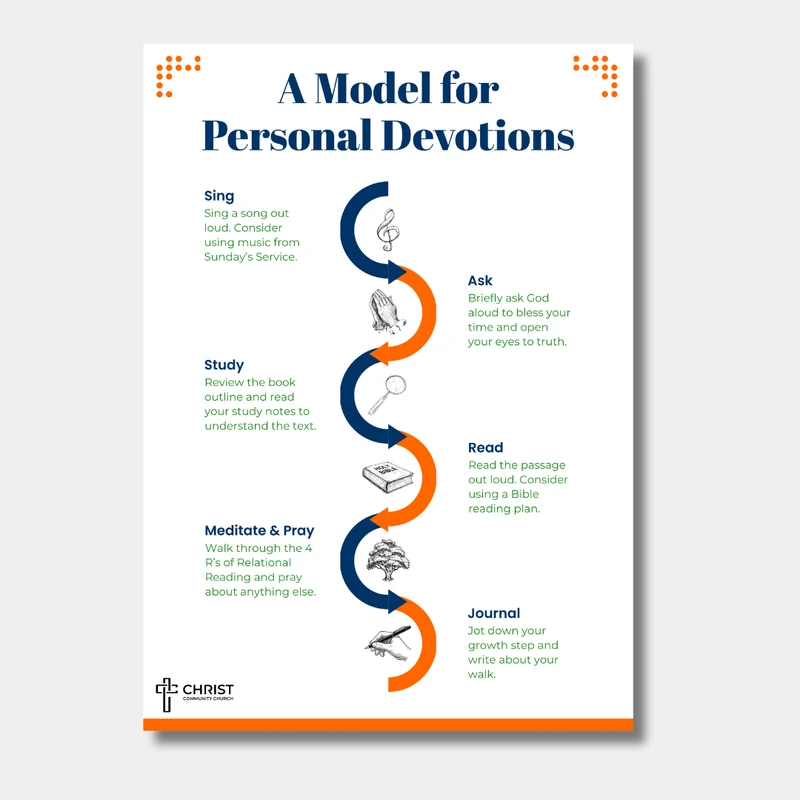
A full-color 5″ × 7″ Quick Guide with the 4 R’s of Relational Reading on the reverse, sized to keep in your Bible. Available for pickup at the Resource Shelf.
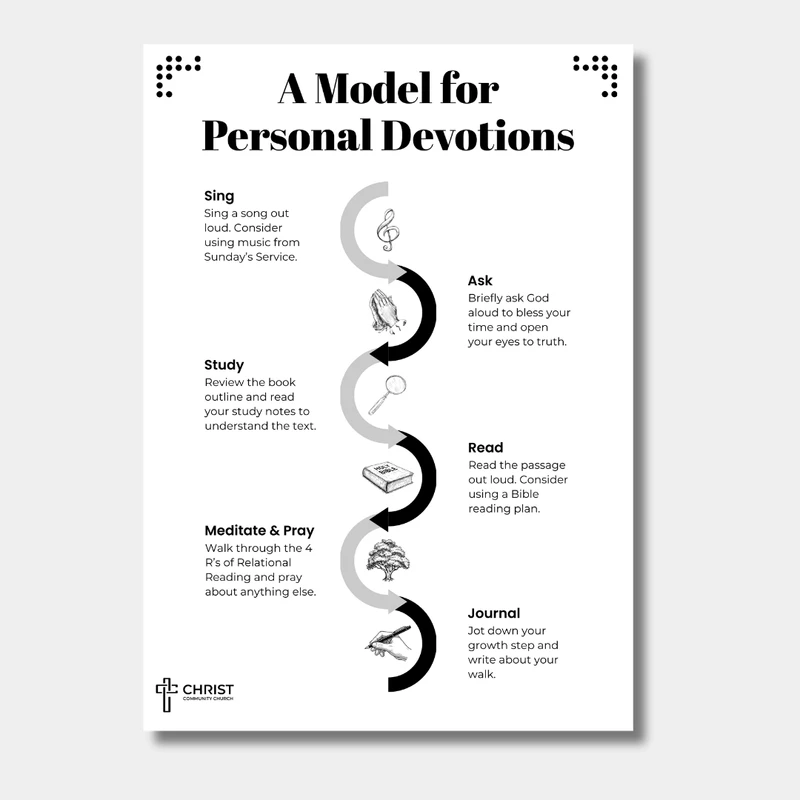
A printer-friendly version that uses less ink and folds in half to fit neatly inside your Bible.