The Best Bible Reading Plan

What is the Best Reading Plan?

The best Bible reading plan is the one that best serves your goals. Many Bible reading plans are available, offering different paths for a wide range of reading goals. If you’re interested in exploring various approaches, here’s a link to over 20 free reading plans available online:

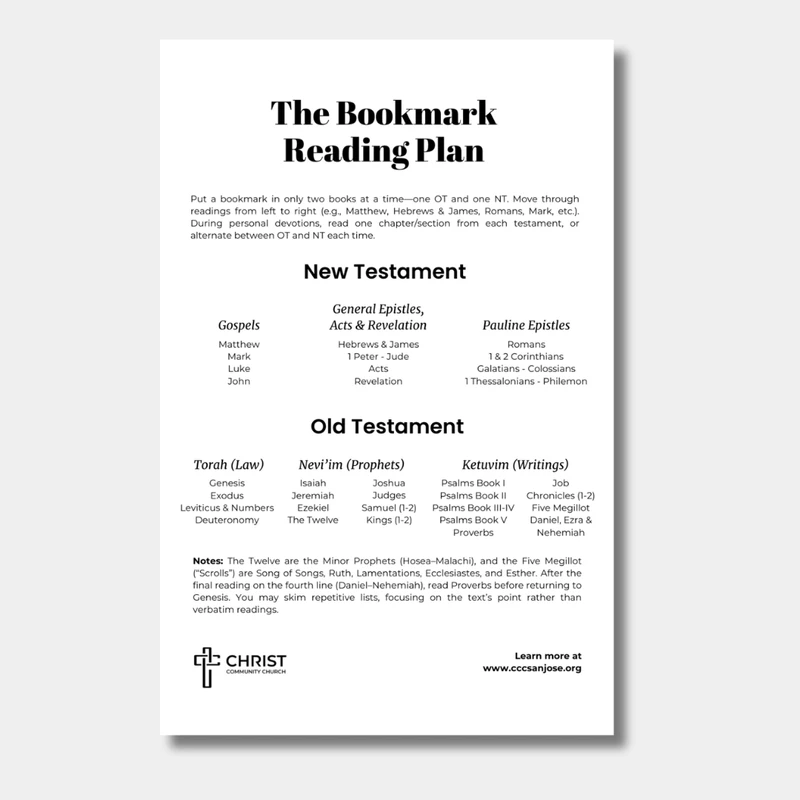
CCC's "Bookmark Reading Plan" is designed specifically for personal devotions. Because we encourage devotions to include not just reading, but also study, reflection, and prayerful engagement, the plan is well suited for a process that is naturally slower and varies in pace from person to person.

There is more than one faithful way to read Scripture. Purely academic studies or reading an entire book in one or two sittings can be deeply beneficial. However, when reading relationally during personal devotions, 30 minutes may only allow time for one or two chapters—or even just a portion of a chapter. Not everyone is able to read every day, and some may have time to read multiple chapters. This plan is designed to support a healthy, well-balanced diet of Scripture no matter how often or how long you are able to read. 

The Goal of this Plan: Self-Paced, Well-Spaced Variety

We recommend being in only two books at a time: 
  • one from the Old Testament
  • one from the New Testament

This helps you keep the larger picture of each book in view. 

We also recommend reading through the entire Bible. While it is possible to accomplish this by reading straight through each testament in canonical order, doing so results in long stretches of the same kind of literature (for example, all four Gospels and Acts in a row, followed by all the Epistles). This plan is intentionally structured to provide greater literary variety while still moving systematically through the full canon of Scripture. 

Many reading plans do the same, but they often place readers in multiple books at once, expect too much reading for those using a relational reading approach, or reduce flexibility by structuring readings around a fixed calendar. We created this plan so that you can move through the entire Bible during your personal devotions at your own, free-flowing pace, in an order designed for well-spaced variety—no matter how frequently you read.

New Testament Structure

The New Testament is divided into three alternating sections:  
  • Gospels
  • Pauline Epistles
  • General Epistles, Acts, and Revelation
The General Epistles (sometimes called "Catholic Epistles" in the sense of "universal") are letters written to a broad or unspecified audience, rather than to a particular church or individual.

Old Testament Structure

The Old Testament follows the ancient tripartite division of the Hebrew Bible: 
  • Torah (Law)
  • Nevi’im (Prophets)
  • Ketuvim (Writings)

Underneath the Prophets, two distinct columns represent the Latter Prophets and the Former Prophets, an ancient categorization referring to the position of these Scriptures in the traditional Hebrew ordering of books. 

Original literary compositions are preserved—First and Second Samuel, First and Second Kings, and First and Second Chronicles were originally single continuous works and are included as such in the reading plan. The Twelve Minor Prophets, while distinct in authorship and historical setting, were traditionally written on a single scroll and are grouped together in the plan. The Five Megillot (“scrolls”)—Song of Songs, Ruth, Lamentations, Ecclesiastes, and Esther—are also grouped together and, according to Jewish tradition, a particular book was read at specific festivals: Passover, Shavuot, Tisha B’Av, Sukkot, and Purim, respectively.

Balanced Readings

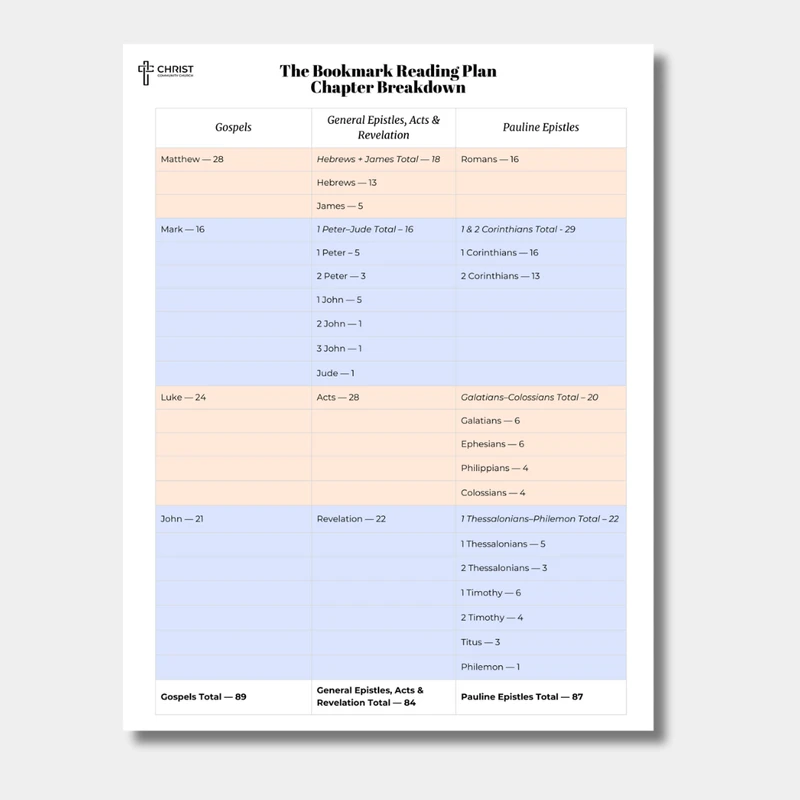
Readings across and within the plan’s sections are intentionally well-proportioned, avoiding large imbalances—such as one section having only a few chapters while the next requires dozens. At the same time, the plan is designed to complete whole books at once, preserving their integrity and flow. For example, in the first sequence of New Testament books: Matthew has 28 chapters; Hebrews and James together have 18; Romans has 16; and Mark has 16. Similarly, in the Old Testament Writings, the Psalter has been divided into its traditional books, seeking relative balance in chapter counts: Book I (41 chapters), Book II (31 chapters), Books III and IV combined (34 chapters), Book V (44 chapters), along with Proverbs (31 chapters) in the same section. A reference chart showing chapter counts by book, reading, and section is included to help visualize this goal of well-spaced variety.  

Thoughtful Order

Attention has also been given to the order of readings across sections. For example, the section containing the General Epistles, Acts, and Revelation follows the Gospels section so that Luke can naturally be followed in sequence by Acts, and John by Revelation. In the Old Testament, the Latter Prophets are positioned between the Torah and the Former Prophets so that narrative material in the Torah is not immediately followed by primarily narrative books but is instead broken up by prophetic literature.   

Using "The Bookmark Reading Plan"

During personal devotions, you may read: 
  • one chapter or section from both the Old and New Testament in a single session, or
  • a New Testament book one day and an Old Testament book another day 

Simply keep a bookmark in each book. Because the New Testament is shorter, this plan will naturally result in spending more time in New Testament literature. This "bookmark based" self-paced approach has appeared in various forms, but the particular order and structure used here are designed to be especially beneficial for Scriptural variety in relational reading.

For both the Old and New Testaments, the columns in the plan are meant to be read from left to right. After completing a book (or group of books) in one section, you move to the next section. For example, you start by reading Matthew, then Hebrews & James, then Romans, and then return to the Gospels with Mark.

All Bible reading plans should be a guide, not a rule! If there is a season when it would be especially helpful to read a particular book of the Bible, you should do so. There is no need to be rigidly committed to any reading plan.

Download Now

CCC’s "Bookmark Reading Plan" is available to download for free in three formats.
Bookmark

Bookmark

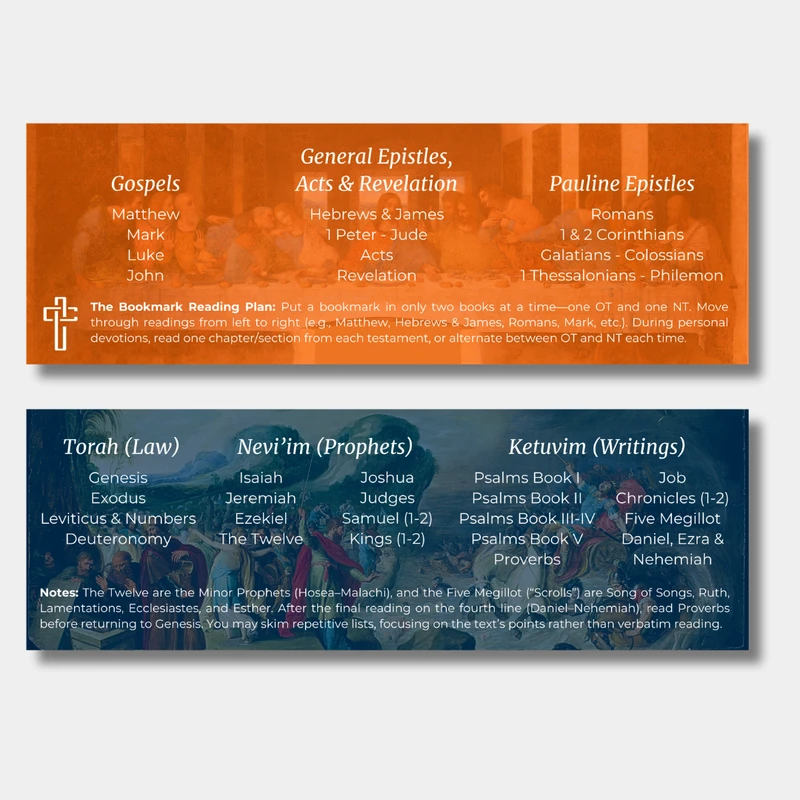
A full-color 2″ × 6″ bookmark, featuring historic paintings of the last supper and red sea crossing.

Printable Insert

Printable Insert

A printer-friendly version designed to be folded in half and kept in your Bible. 
Chapter Breakdown

Chapter Breakdown

A reference chart showing chapter counts by book, reading, and section to illustrate how quantities are distributed.

Questions About the Relational Reading Plan?